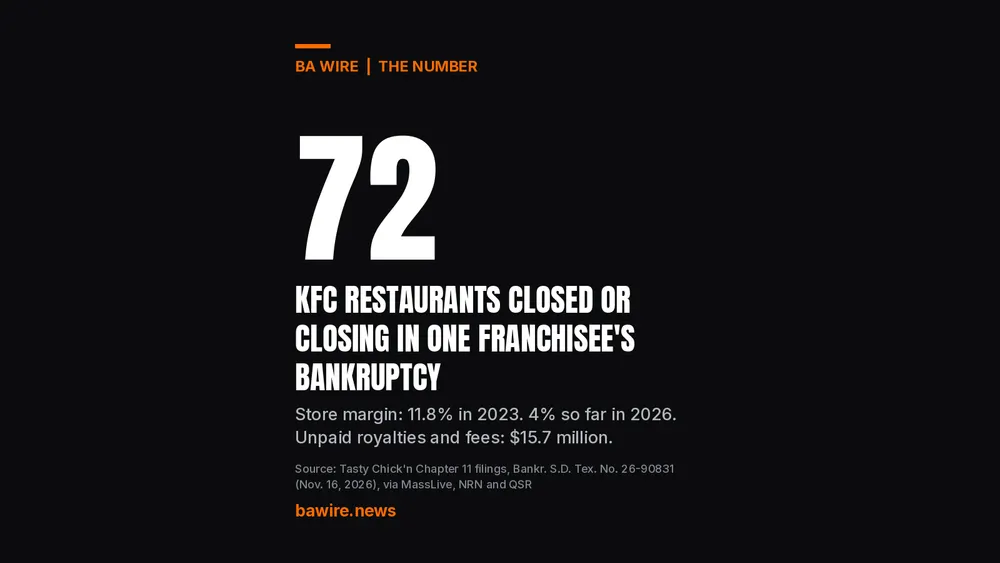
A KFC franchisee in Plano, Texas, filed for Chapter 11 on Nov. 16. Its court papers list 72 restaurants that have closed or are closing.
At some of them, the company left the keys in lockboxes for the landlords, according to MassLive's review of the filings.
KFC is not in bankruptcy. The operator is. And the filing shows exactly how a franchise gets squeezed from both ends.
Who filed
Tasty Chick'n LLC runs 75 KFC restaurants and nine KFC/Taco Bell combos, 84 in all, across 10 states (Nation's Restaurant News, Nov. 17, 2026). Three affiliates filed the same day in the U.S. Bankruptcy Court for the Southern District of Texas, case No. 26-90831.
The company asked the court to let it drop leases at 72 locations it says have "already shut down" or are "winding down business." Tennessee has 24 of them, 14 in Memphis. Arkansas has 10. Kentucky and Florida have eight each (MassLive). The filing does not say which are already dark.
The numbers in the CEO's sworn declaration
- Sales fell three years straight: down 11.4% in 2024, 1.4% in 2025 and 2.8% so far in 2026, about 15.6% in all (QSR Magazine; NRN).
- Store margin went from 11.8% to 4% between fiscal 2023 and fiscal 2026 to date, as food, labor, operating costs and rent rose (NRN).
- Store-level earnings fell to about $7.1 million over the last 12 months, from $12.4 million a year earlier (NRN; QSR).
- $15.68 million owed to the franchisor. Most of it is $7.9 million in advertising contributions and $5.6 million in royalties (QSR).
- About $67.2 million owed to lenders led by MidCap Financial Trust, plus a $5 million note to a prior seller (QSR).
- About $3.1 million in cash at filing, against about $194 million in annual revenue and about 1,646 employees (QSR).
That is the whole story in one line. Revenue down 15.6%. Margin down by two thirds. Then the royalty checks stopped.
The Friday Brief tracks filings like this one every week. Join free.
How it unraveled
The company was formed in 2021. It bought 90 restaurants from Fowler Foods that year and 64 more from JRN, Inc. in 2024 (QSR). Sales fell every year after.
It started putting off royalty payments in mid-2025 and mostly stopped paying them in November 2025. The franchisor sent a default notice that December. On Sept. 15, 2026, it sent notice that it intends to end the franchise agreements (QSR; NRN).
Losing the franchise means losing the right to use the KFC and Taco Bell names. CEO Thomas M. Scott said that would wipe out the value of the business and put the company in default on its bank loan. He said it was "caught between" its lender and its franchisor after more than a year of talks with both (QSR).
The landlords were already in court. The company faces about 14 real estate lawsuits in five states, mostly over unpaid rent, seeking more than $2 million in total. The largest, over a restaurant in Robinson, Ill., seeks about $1.8 million (QSR). The bankruptcy filing paused all of them.
One more cost was coming. Another 37 restaurants face franchisor remodel or upgrade requirements through 2029 (QSR).
What is for sale
The company wants up to $20 million in bankruptcy financing from MidCap to keep operating (NRN). It hired Guideboat Advisors and Peak Franchise Capital, began outreach in July and started a formal sale process in October. The restaurants are being marketed as one package, market by market, or in combinations. Any sale needs court approval and KFC's consent (QSR).
In a statement to NRN, a KFC spokesperson said the company remains "confident in the strength of our brand."
What It Means
1. Watch the margin, not the sales line. Sales here fell about 15.6% over three years. The margin fell from 11.8% to 4%. If you own or lend to a franchise, the gap between those two numbers is the warning. Track store-level margin every month.
2. Unpaid royalties are the tripwire. Deferred royalties led to a default notice, then a termination notice, and termination would have triggered a loan default. Owners: talk to your franchisor and lender before the first missed payment, not after. Lenders: ask for royalty statements, not just bank statements.
3. Buyers and brokers, read the remodel list first. A court-supervised sale can be a chance to buy restaurants by market. But 37 of these stores carry remodel requirements through 2029. Price the capital bill and the franchisor's approval into any bid.
Sources: Tasty Chick'n LLC et al., Chapter 11 petitions and first-day filings, U.S. Bankruptcy Court, S.D. Tex., No. 26-90831 (filed Nov. 16, 2026), as reported by Nation's Restaurant News (Nov. 17, 2026), QSR Magazine (Nov. 17, 2026) and MassLive/Syracuse.com (updated Nov. 18, 2026); first-day declaration, Doc. 22.
Get the Friday Brief. One free weekly email on small-business distress, debt and deals, every number sourced. Sign up free.