St. Louis Fed President Alberto Musalem said Tuesday that the economy will likely need several interest rate increases before the spring of 2027. The Federal Open Market Committee is still holding the federal funds target at 3.75% to 4%, the range it kept on Oct. 28.
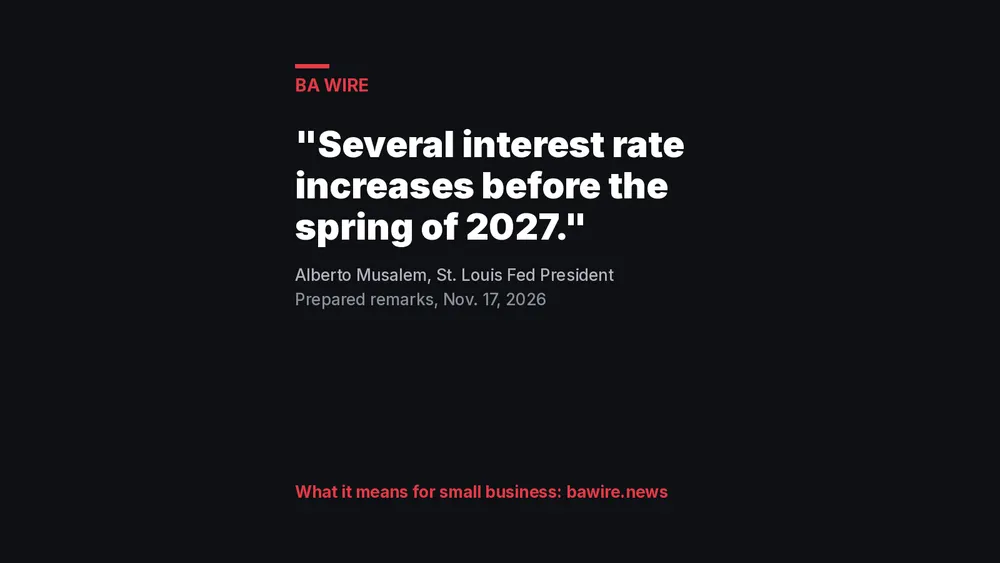
In prepared remarks for a Central Bank of Argentina conference, Musalem put it this way: "The economy will likely require several interest rate increases before the spring of 2027 to achieve price stability in a timely manner."
For a small-business borrower, that is not a speech about the long run. It is a warning that floating-rate loans, lines of credit and credit cards may get more expensive well before next spring.
What he said
Musalem, who leads the Federal Reserve Bank of St. Louis, said inflation is "too high" and that "risks are skewed toward persistent above-target inflation." Headline and core inflation, he said, "continue to run higher than 3%." Using October consumer and producer price data, he estimated that October headline and core personal consumption expenditures inflation "could be 3.8% and 3.2%, respectively."
He argued that policy is not yet tight enough. In the scenario he called likely, the economy will need a real policy rate "solidly between 2% and 2.5%" before the spring of 2027. He estimated the real policy rate is "at the lower end of the 1% to 1.5% range today." That is about a percentage point of tightening, and he said "the nominal policy rate may need to do most of the work."
He also left a door open. There is "an unlikely but still plausible scenario," he said, in which inflation falls back toward 2% in 18 months without another rate increase, if energy and shipping costs drop, productivity rises, or demand slows. He judged the first scenario more likely, and said "further removal of monetary policy accommodation will be required soon." Acting sooner, "while inflation expectations are anchored, has a better chance of succeeding without adverse impact on the labor market or economic growth."
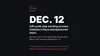
The remarks come after the Fed already raised rates once this cycle. Musalem pointed to "our September policy action" and said he agreed with Chairman Kevin Warsh's description of that increase as "removing a dose of accommodation." Then, on Oct. 28, the FOMC voted 10-2 to hold the target range at 3.75% to 4%. Governors Lisa D. Cook and Cleveland Fed President Beth M. Hammack dissented; they wanted a quarter-point increase at that meeting. The next scheduled FOMC meeting is Dec. 8 and 9.
What it means for a small-business borrower
A higher federal funds rate does not stay inside the Fed. Prime, variable-rate term loans, revolving lines, many SBA loans, credit cards and some equipment leases reprice off it, or off indices that move with it. Several increases before spring would raise the cash a borrower has to find each month, on debt that often sits behind a personal guarantee.
Musalem also said financial conditions have already tightened some since September, and that credit spreads have widened for high-yield and cyclical borrowers. Housing, he said, is already a headwind because of high mortgage rates. If the Fed follows the path he favors, the window to lock a fixed rate at today's 3.75% to 4% target will not stay open until spring.
What to do now
- Map every floating-rate facility. List each loan, line, card and lease that moves when the Fed moves, and write down the index, the spread and the next reset date.
- Call your lender before the Dec. 8-9 meeting. If you want to lock a fixed rate, extend a maturity or convert a variable line, do it while the target range is still 3.75% to 4%.
- Stress-test cash flow for several quarter-point increases before spring 2027. Include the personal guarantee behind the debt, and decide now what gets cut if the payment goes up.
If you work with distressed businesses
Turnaround and restructuring pros: ask clients this week which of their facilities reprice off prime or SOFR, and whether they can service several more increases before spring.
Lenders: a borrower who barely clears coverage at 3.75% to 4% will not look the same after several hikes. Review those files before December.
Brokers and advisors: owners who have been waiting for cheaper money may not get it. The sale or refinance conversation belongs on the calendar now, not next spring.
Sources
- Alberto Musalem, Remarks on the U.S. Economy and Monetary Policy, Federal Reserve Bank of St. Louis, Nov. 17, 2026
- Prepared text of the same remarks (PDF)
- Federal Reserve, FOMC statement, Oct. 28, 2026
- Transcript of Chairman Warsh's press conference, Oct. 28, 2026
- Federal Reserve, FOMC meeting calendars
- CNBC, St. Louis Fed's Musalem says four more rate hikes may be needed in coming months, Nov. 17, 2026