
By BA Wire Data Desk
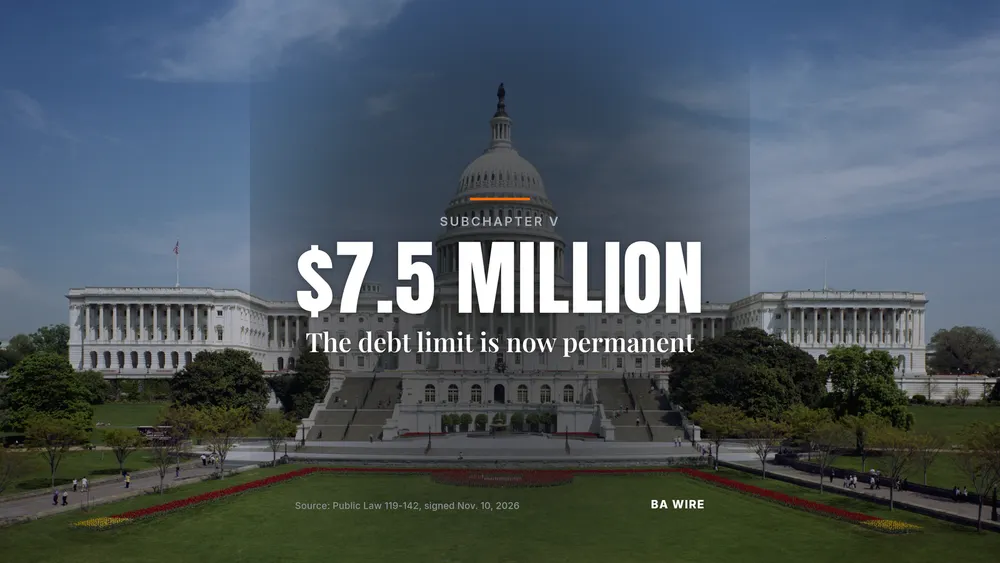
Small businesses with up to $7.5 million in debt can again use Subchapter V, the faster small-business track inside Chapter 11. The President signed H.R. 7730, the Bankruptcy Threshold Adjustment Act, on Tuesday, Nov. 10, 2026, according to the White House. Congress.gov lists it as Public Law 119-142.
The law sets the Subchapter V debt limit at $7,500,000 in noncontingent, liquidated secured and unsecured debts, not counting debts owed to affiliates or insiders, according to the amended text of 11 U.S.C. § 1182. At least half of that debt still has to come from the business. The change applies to cases filed on or after Nov. 10, 2026, and it has no sunset date.
Before the law, the limit was $3,424,000, according to the National Association of Consumer Bankruptcy Attorneys. That is an increase of $4,076,000. The U.S. Bankruptcy Court for the Northern District of Illinois described the change as permanently restoring the $7.5 million limit, which had previously been temporary.
Owners who file personally are covered too
The same law replaces Chapter 13's two separate debt ceilings with one combined limit of less than $2.75 million. Before, a filer had to be under $526,700 in unsecured debt and under $1,580,125 in secured debt, according to NACBA. That matters to owners whose business debt has followed them home through a personal guarantee.
Courts are already changing their paperwork. The Northern District of Illinois said Official Form 201, the voluntary petition used by businesses, was amended to change Question 8 to match the new law. The District of Oregon and the District of South Carolina posted similar notices.
More small businesses were already choosing this track
Subchapter V elections rose to 280 in October 2026, up 24% from 225 in October 2025, according to Epiq AACER data published by the American Bankruptcy Institute on Nov. 6. Overall commercial bankruptcy filings fell 4% in the same month, to 2,762. In the first nine months of 2026, Subchapter V elections totaled 2,442, up 46% from 1,672 a year earlier, ABI reported on Oct. 8.
Subchapter V was created in 2019 by the Small Business Reorganization Act to streamline the process and reduce costs, according to the U.S. Courts. Small business cases move on accelerated deadlines compared with a traditional Chapter 11.
What it means
For an owner carrying roughly $3.4 million to $7.5 million in business debt, the small-business reorganization track is now available where it was not before Nov. 10. Whether a specific company qualifies depends on how its debts are counted, which is a question for a bankruptcy attorney before anything is filed.
For buyers and turnaround professionals, the larger ceiling widens the pool of operating companies that can reorganize through Subchapter V instead of a standard Chapter 11 or a Chapter 7 liquidation. The October numbers show that pool was already growing.
Sources
- The White House, Congressional Bills H.R. 997, H.R. 1703, H.R. 1945, and H.R. 7730 Signed into Law, Nov. 10, 2026
- Congress.gov, Public Laws, 119th Congress (PL 119-142, H.R. 7730, Nov. 10, 2026)
- 11 U.S.C. § 1182, as amended by Pub. L. 119-142
- NACBA, President Signs H.R. 7730, Nov. 10, 2026
- U.S. Bankruptcy Court, N.D. Illinois, Bankruptcy Threshold Adjustment Act Signed Into Law, Nov. 13, 2026
- ABI, October Small Business Subchapter V Elections Increase 24% Year Over Year, Nov. 6, 2026
- ABI, Small Business Subchapter V Elections Increase 46% Compared to Last Year, Oct. 8, 2026
- U.S. Courts, Chapter 11 Bankruptcy Basics