By BA Wire Data Desk
The federal government is collecting on pandemic loans, and the point where a COVID Economic Injury Disaster Loan leaves the Small Business Administration is the point where most of an owner's options disappear. Forbes reported on Nov. 1 on owners now receiving Treasury collection demands. The official record behind those letters is below.
The referrals
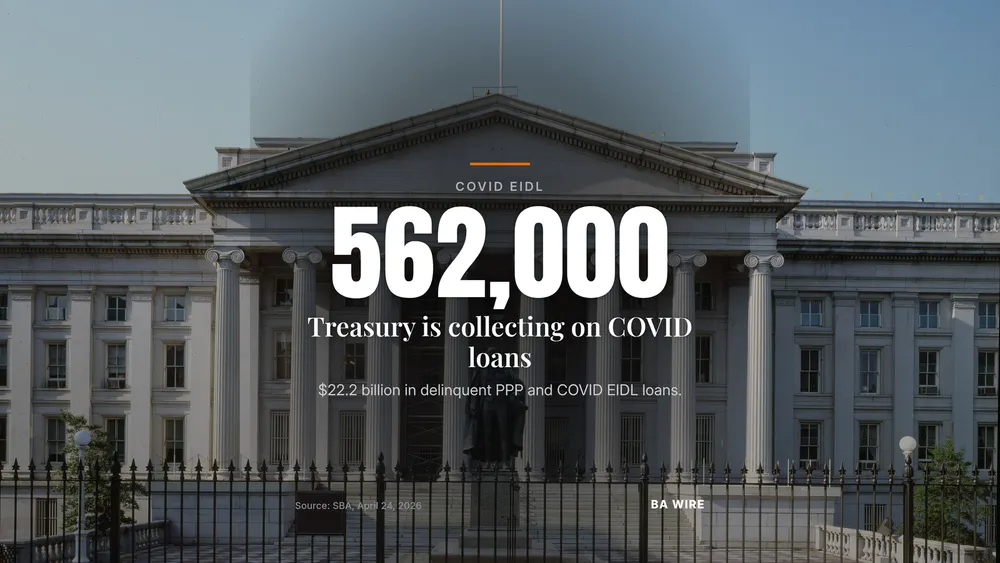
On April 24, 2026, the SBA said it had referred 562,000 suspected fraudulent loans to the Treasury Department for collection, tied to $22.2 billion in delinquent Paycheck Protection Program and COVID EIDL loans. The agency called it its largest referral package on record.
On Sept. 14, 2026, the SBA said it had suspended 870,000 borrowers connected to an estimated $39 billion in suspected PPP and EIDL fraud. Suspended borrowers cannot receive future SBA small-business or disaster loans. The agency also began sending final 30-day demand letters, starting with about 8,000 borrowers in Kansas and Missouri.
What changes when a loan goes to Treasury
- The SBA steps out. Once a loan is referred to Treasury's Cross-Servicing program, it is no longer serviced by the SBA, and the SBA cannot help, according to the SBA's COVID EIDL page. Treasury says it cannot return COVID EIDL debts to the SBA.
- The balance can grow. Transfers to Cross-Servicing may add interest and collection fees of up to 28%, the SBA said in its Sept. 14 release.
- Federal payments can be taken. Through the Treasury Offset Program, the government can offset tax refunds, contractor and vendor payments, federal salaries, and Social Security and other benefit payments, according to the same release. The SBA says an account may be referred to the offset program after 120 days of delinquency.
- A private collector may hold the debt. Treasury says a demand letter can take up to 21 days to arrive after referral, and that it cannot help with debts placed at a private collection agency. Those owners have to use the contact information in their letter.
What is still available before referral
The SBA offers COVID EIDL borrowers a 50% payment reduction for six months, available once every five years, through its loan portal. To qualify, the loan must be current and less than 90 days past due, the business must be open and operating, no owner can be in an active bankruptcy, and the problem must be a temporary cash-flow issue. Interest keeps accruing during the six months, which makes the balloon payment at the end of the loan larger. For loans originally approved above $200,000, the SBA asks borrowers to email COVIDEIDLServicing@sba.gov.
If a loan is charged off but has not yet gone to Treasury, the SBA says the borrower can pay the full overdue balance through the portal and then ask for the loan to be reinstated to current status.
The dates that matter
Under 90 days past due, the SBA's hardship program is open. At 120 days, the loan can be sent to the Treasury Offset Program. Once it reaches Cross-Servicing, the SBA is out of the picture. Treasury's Cross-Servicing call center is 1-800-289-7388.
For buyers, any seller who took a COVID EIDL should be able to show whether the loan is current, in SBA payment assistance, or at Treasury. The SBA treats a change of ownership on a COVID EIDL as a servicing action with its own process.
Sources
- SBA, SBA Sends 562,000 Suspected Fraudulent Loans to Treasury for Collections Totaling $22 Billion, April 24, 2026
- SBA, SBA Announces Suspensions for 870,000 U.S. Borrowers Tied to $39 Billion in Suspected Pandemic Fraud, Sept. 14, 2026
- SBA, COVID-era programs: COVID-19 EIDL payment assistance and servicing, retrieved Nov. 14, 2026
- Bureau of the Fiscal Service, Cross-Servicing Contact Us and SBA COVID EIDL update, last updated June 18, 2026
- Forbes, John Schroyer, They Took Small Business Loans During COVID. Now The Government Is Coming To Collect, Nov. 1, 2026